The
Bushwhacker
Part II of II
By: Dusty Williams
Whether
or not this murdered man was in fact The Great
Bushwhacker, Bill Wilson, we may never know,
but someone was murdered none the less and the
name of Wilson, from Missouri, was given to
the identity of the man. It is hard to imagine
that such a great man could have been gunned
down in this manner, however authorities in
Missouri had often remarked that they could
get Bill Wilson if only he would leave the
hills. Perhaps leaving the hills was his fatal
mistake. It is unknown what exactly happened
to the body of this man. Some say the
murderers buried him in a shallow grave near
the trail (a quarter of a mile, according to
the before mentioned article). Regardless of
this, he was obviously not buried properly if
the citizens of Mantua found him and created a
search party. He was likely covered with brush
and other debris to somewhat hide his remains.
What the citizens did with his body it is not
known. They could have buried him where he
lay, or perhaps they took him back to Mantua
and buried him in their city cemetery there.
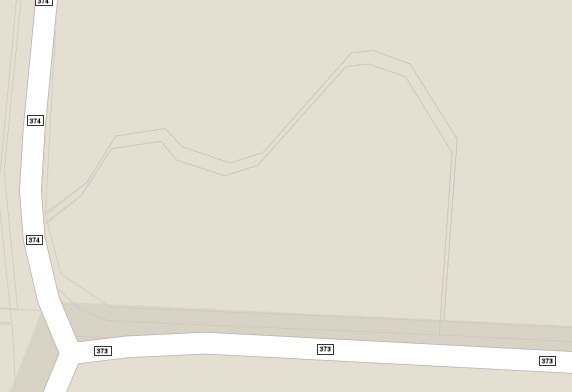
This cemetery is located at the northeast
intersection of county roads 573 and 574,
however there is little evidence of its
existence.
There
is a rumor that the body was buried by the
murderers near Highway 5 and Prong Creek,
being north of Van Alstyne. Roy F. Hall wrote
an account of this historic event, however
there are several errors with his story. I
have not been able to find any proof that the
murder took place this far north. According to
some accounts, William C. McKinney was hunting
and heard the shots. McKinney’s land was near
Mantua, almost due east of it near the
Grayson-Collin County line. The before
mentioned newspaper accounts also stated that
the citizens of the community heard the
shots…Mantua was too far away to have heard
the shots had it occurred north of present
day, Van Alstyne. It seems more likely that it
had occurred south of present day Van Alstyne
between here and Mantua, but on the Grayson
County side. A fiftieth anniversary edition
of, The
Sherman Courier, on August 15, 1917
retails the account and states that “the
traveler left for the north and these men
(Thompson and Blackmore) followed him,
overtaking and murdering him at night in
Grayson County, south of Van Alstyne.” It is
also important to remember that in 1869,
neither Van Alstyne nor the Railroad were in
existence. Prior to the Interurban’s creation
in the early 1900’s, highway 5 did not exist.
When traveling to Howe from Van Alstyne, one
would have taken what is now called Old
Highway 6. When the interurban disbanded in
later years towards the middle part of the 20th
century, its remains were turned into highway
5. Being a murder case, it is unlikely that
the posse would have buried the body where
they found it when they had a city cemetery in
their community of Mantua. There were also
several family cemeteries nearby including the
McKinney Cemetery which later became the Van
Alstyne Cemetery.
Bushwhacker
Bill Wilson’s widow, Mary was remarried to
John Jackson in Missouri in 1884. The
following is taken from the Rolla Herald
in 1883 just prior to his marriage. It appears
he had planned to marry Mrs. Wilson, but
wanted to ensure that she was in fact a widow.
“Mr. John Jackson returned last week from a
trip to Texas. While at McKinney he learned
the particulars of the death of William
Wilson, a brother of the late Napoleon Wilson,
who went to Texas soon after the war for the
purpose of buying a home. Mr. Jackson showed
us a McKinney paper, dated January 30, 1869,
in which an account is given of a foul murder
and robbery of a stranger from Missouri, and
from the description given Mr. Jackson is
satisfied that the murdered man was William
Wilson. He had on his person at the time he
was murdered about $3500. His widow and
relatives in the county, so we are informed,
have never believed him to be dead, but the
description of the murdered man tallies
exactly with that of Wilson, and Mr. Jackson
investigated the matter while there and is
satisfied beyond a doubt that William Wilson
was murdered for his money and that the person
spoken of in the paper was no other than
William Wilson.”
Ironically
in the movie, The Outlaw Josey Wales, at the
end, his alias name is given as, “Mr. Wilson.”
Coincidence? It is also said that the
bar/saloon in which Josey Wales frequented in
the movie and the place where his alias was
given to the authorities was styled after
James “Jim Crow” Chiles’ saloon which was
located in Sherman during the Civil War and
where Quantrill’s men were frequent customers.
The names of Bob Lee and Simp Dixon were also
mentioned in the movie, both parties having
been involved in the Pilot Grove Difficulty,
just east of Van Alstyne. Whether or not the
character of Josey Wales was in fact molded to
reflect Bill Wilson may never truly be known
as parties argue from both sides of the
matter, however, Josey Wales and Bill Wilson
lived very similar lives as most Bushwhackers
did at the time. For many in the Ozarks, Bill
Wilson appeared to be somewhat of a hero who
could never be defeated…in the hills of
Missouri that is.
Even
today many wonder if Bill Wilson was ever
really killed. He never, in all his escapades,
was injured by the authorities. Perhaps he
took this as an advantage that a man was
murdered and somehow placed his name to the
corpse to give himself a new start. Many old
time folks in Missouri say that they saw Bill
Wilson long after this and that he lived to an
old age taking an assumed name. A similar
story like this exist in the case of Jesse
James. With cases such as these, rumors seem
to always spread that the dead are not really
dead, perhaps it is a way to cope with the
loss of a great hero who all thought could
never be killed. Perhaps the Titanic is still
afloat somewhere in the Atlantic? No matter,
someone was murdered near Mantua and the two
men convicted of the murder were the first two
men to be legally hanged in Sherman in 1869.
This story can be found in the next
installment of, Trails of Our Past entitled,
“To the Gallows.”