John Baptiste Carlat
 ESCAPE FROM THE COMANCHES
The Sunday Gazetteer
Sunday, July 6, 1902
pg. 2
John Baptiste Carlat, who passed away a few
weeks ago, related to the writer the
following particulars of his escape from the
Comanches, who held him a prisoner for a
period of two years. At that time
Carlat was a young man, and the Indians did
not torture their captives, as the white man
had not as yet trespassed on their lands.
The white settlements in Texas were
very scattered, and did not number perhaps
all told 2000 souls.
The Indians confined their depredations to
stealing horses, and frequently pushed their
incursions almost to the border of Louisiana
on the east.
Mr. Carlat was carried to the Ft. Sill
country, but no frontier post had as yet
been established there. The Comanches
treated Mr. Carlat very kindly and he was
frequently a member of their hunting
parties. They had as captives three
white women but for some reason he was not
permitted to hold any intercourse with them.
On day a war party arrived from the
border of Mexico with several white Mexican
women. A hacienda had been raided, the
men killed and the women carried into
captivity. On the points of their
spears the warriors carried the
blood-reeking scalps. That night a
large fire was built and the braves dance
with fiendish glee around the ghastly
trophies which were suspended from the tops
of poles. All night pandemonium
reigned; the din was terrible. Many of
the dancers yelped like wolves, bellowed
like buffalo, and screamed like owls.
The Mexican captives were obliged to
witness the horrible orgies that
commemorated the massacre of perhaps a
husband, brother or dear friend. The
next day there was a great feast on buffalo.
Mr. Carlat stated that he saw in the
Canadian country and along the old Santa Fe
trail millions of buffalo. The earth
trembled beneath....(page torn)
It was not an unpleasant life that he lead
among the Comanches. A Frenchman can
adapt himself to circumstances better than
any nationality that we know of. In
almost every tribe on the American continent
the Courier de Boise or Canadian French
could be found. Frances Parkman, the
most delightful historian of colonial and
frontier life, and who lived with the
Dakotas for two years, says that the French
trader looked and acted so much like the
Indian that it was hard to draw the line.
The chiefs wanted Mr. Carlat to take unto
himself an Indian wife, and to become a
member of the tribe. He humored them,
but his purpose was to escape at the most
favorable opportunity. It came at
last. One evening just at dusk he saw
away in the distance what looked like a
white streak creeping over the green
prairie. There was a large river that
had to be crossed, and the spring...had
filled it bank full. The die was cast,
and he determined to escape if it cost him
his life. He selected the best horse
in the Indian encampment for the enterprise,
and while the camp was wrapped in slumber
and there was an incessant barking of Indian
dogs, Mr. Carlat stole forth into the shadow
of the night. Guided by the stars, he
directed his course to the river. It
was a hard and furious ride. At last
the bank was reached, and Mr. Carlat gave
his horse a free rein and plunged in.
The current was strong, the river
wide, and it looked for a time as though the
rider would never reach the opposite
friendly bank. The horse was carried
down with the current for nearly a mile
before a landing was effected. About
daylight he reached the camp of a large
party of U.S. dragoons [mounted
soldiers], who had come down
through Kansas and were heading for the
Santa Fe trail, their destination being
Taos, New Mexico.
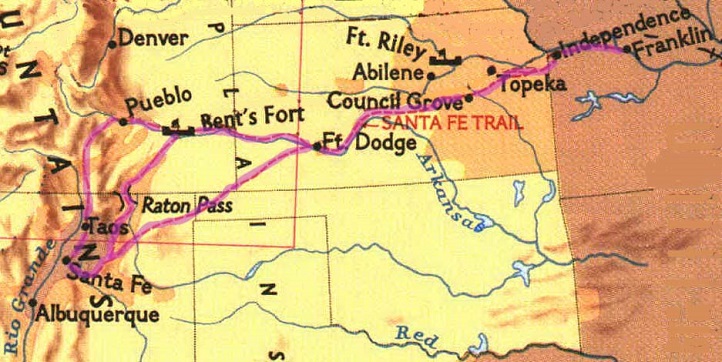
(source:
rootsweb.com Photographic Archives of
the Santa Fe Trail)
Mr. Carlat was confident
that his Indian friends would never attempt
to swim the river in pursuit, and he never
saw them anymore. It was on this trip
that he first met the celebrated
frontiersman Kit Carson, who was a scout for
the dragoons. When Carlat rode into
the camp of the soldiers, they had no idea
he was a white man. They thought he
was a full fledged Comanche warrior.
That was his first introduction to the
life and vissitudes of a scout. In
after years he became one of the most famous
of them.

The Sunday Gazetteer
Sunday, July 13, 1902
pg. 2
CARLAT AND GRANT
When Grant was unknown to fame and used to
haul cord-wood to St. Louis for a
livelihood, the late Mr. Carlat, who died in
this city last week [sic], met him
frequently. The Carlat farm and Dent
farm joined, and consequently they became
quite intimate.
In those days, there was nothing to indicate
the greatness that lay dormant in Grant.
He was as common a man as was seen on
the streets of St. Louis. He was fond
of his dram and probably went home many a
time feeling a little worse for his liquor.
Mr. Carlat was a convivial spirit, and there
was a mutual feeling between him and Grant.
They have stood at the bar many a time
sipping their toddy and comparing notes.
There was a public square for wood
haulers, and Grant would tie up at the rack
and stand by his horses waiting for a
customer. Some times the customer
would never come and Grant would haul his
wood back home. He tucked his pants
into his boots, and carried a buckskin whip.
Mr. Carlat said that Grant was a very
pleasant and agreeable man and capable of
telling a good story.
Mr. Carlat sold out and moved away, and that
was the last that he ever saw of the great
general, who commanded over two millions of
men and was twice president of the United
States, and received in pomp and state by
every crowned head in Europe.
Mr. Carlat used to often think of the old
days passed with Grant in St. Louis.
He little dreamed that he was touching
elbows with a man who will go down to
history as "the man of destiny."
Grant never forgot his old friends; he
delighted to entertain them, and never
hesitated to do something for them if they
needed an office. For this he was
roundly reprimanded. His confidence
was frequently abused. This is
illustrated in the St. Louis whisky ring
with Babock at the head. Under the
guise of an old friendship they dragged
Grant's name down with them.
The fact that Grant and Carlat served in the
same army and under the same general in the
Mexican war naturally produced a lasting
friendship, although Carlat never asked
anything at the hands of Grant.
Visit The Carlat Family Page
Biography Index
Susan Hawkins
©2025
If
you find any of Grayson County TXGenWeb links inoperable, please send me a
message.