William
Henry Robert, Sr.
William
Heny Robert, Sr. was born June 15, 1821 on
Cotton Hill Plantation,
Jasper Co., South Carolina, the second son
and child of Rev. James John
(Jehu) Robert, Jr. and Phoebe Mosse
McKenzie. His first wife was
Georgia Washington Clark (1822 - 1870), whom
he married at the age of
19 in Columbia, Richland Co., South
Carolina. They had ten
children - three sons, all doctors, and
seven daughters.
While
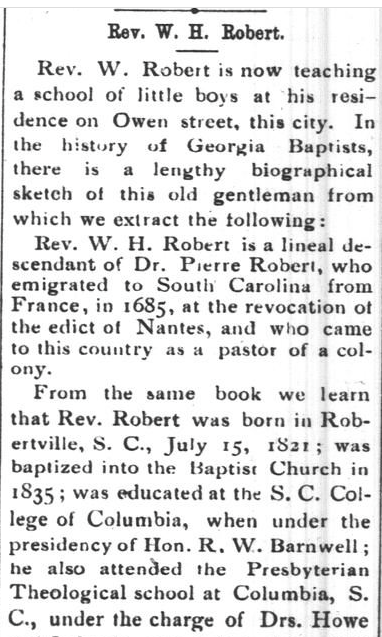
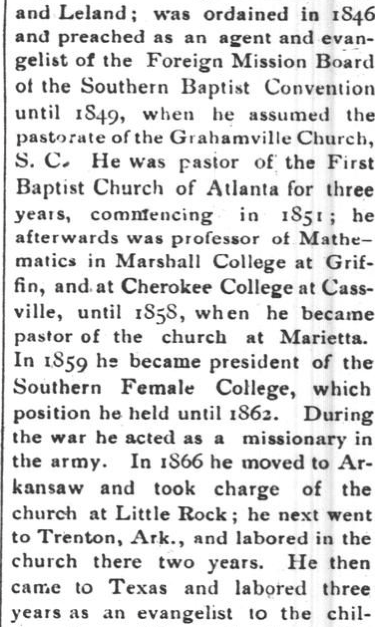
living in Georgia, Rev. Robert became
President of the Southern Female
College at LaGrange, Georgia in 1859.
During the Civil War Rev.
Robert, who had been ordained in 1846, was a
missionary in the Army.
After the war he moved to Arkansas in
1866 and continued his
ministerial work. Georgia
died in May 1870 in Arkansas. He then
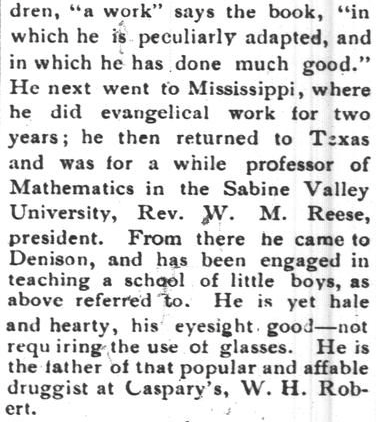
came to Texas, laboring 3
years as a youth evangelist. It is
possible that during this time
in Texas, Rev.
Robert, aged 52 years,
married Antoinette Emily
Lea Bledsoe Power in Washington Co.,
Texas in 1874.
They lived in Mississippi where
he did evangelical work for
two years before returning to Texas.
In 1884 Rev.
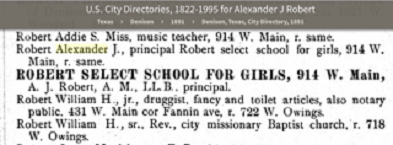
Robert operated a school for boys in
Denison, Texas while his younger brother, Alexander John
Robert operated Robert Select School
for Girls in 1896.
The Sunday
Gazetteer
Sunday, September 7, 1884
 W.H. Robert, Jr. ~
Druggist
W.H. Robert, Jr. ~
Druggist
At
the beginning of April 1885 Prof. W.H.
Robert had to close his school
for a couple of months due to protracted
illness upon the advice of his
physician. However, he planned to
re-open the school in June.
(The
Sunday Gazetteer, April 5, 1885,
pg.4)
It
appears that W.H. Robert chose a different
course of work over the
re-opening of his school for boys since
about a year later, he is
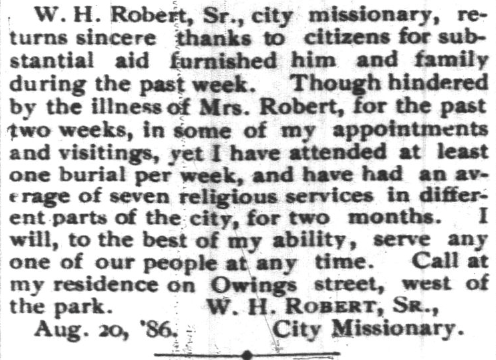
the "City Missionary" for Denison,
performing weddings, holding
services in different areas of the city and
attending burials and held that position at
least through 1896.
The Sunday Gazetteer
Sunday,
July 4, 1886
pg.3
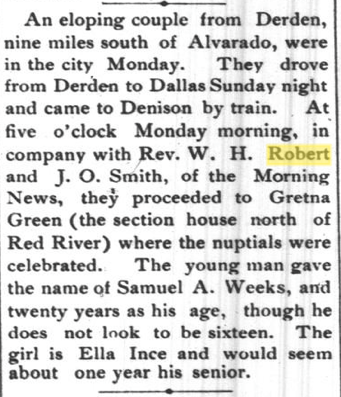
Note: Derden is in Hill Co., southern neighbor
to Johnson County, where Alvarado is located.
The couple traveled approximated 115 miles to
Denison.
The Sunday Gazetter
Sunday, July 25, 1886
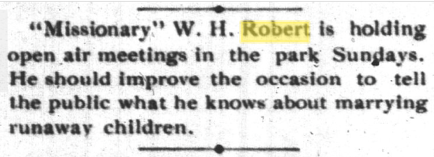
While
the evangelist's activities generally earned
praise, he raised eyebrows
with his willingness to perform a particular
type of wedding. In Texas,
to be legally married, a couple had to
secure a marriage license at the
county courthouse and wait a certain period
before the ceremony. In
Indian Territory, however, this was not the
case; any wedding ceremony
performed by an ordained minister was legal
there. This made Denison a
"destination" for eloping couples whose
relatives might be in hot
pursuit. They would take a train to Denison,
engage a knowledgeable
hack driver who would guide them to the
Robert house on Owings Street
and then drive them and the minister to the
ferry across Red River.
Once on the other side, the group would
proceed a certain distance to
"Gretna Green" (as the Gazetteer
called "the section house
north of Red River," alluding to a village
in Scotland that was famous
for runaway marriages). There the preacher
would perform the ceremony.
Then the group would return.
B.C. Murray, editor of the Gazetteer,
frowned on Reverend Robert's willingness to
perform this service for
young couples and often mocked the
minister's actions in print,
sometimes implying financial motives. On
January 3, 1886, the Gazetteer
published the minister's response: "I marry
only those who promise to
be 'one and inseparable, till death parts
them,' and I have not sought
couples to be married. . . . I scorn
everything that is low and
dishonorable, and in marrying people only do
as I would have others do
to me and my children. If the friends of the
parties are satisfied,
others have no right to complain."
On November 6, 1887, the Gazetteer
reported a case in which Reverend Roberts
refused to perform a ceremony
when he learned that the couple involved
"were only casual
acquaintances when they left Ennis last week
for the Dallas fair." He
referred them to another cleric in Indian
Territory. The Gazetteer
puckishly lauded the minister for "forsaking
his vices in his old age."
Perhaps the newspaper was correct in
thinking that Mr. Robert had
changed his mind about performing this type
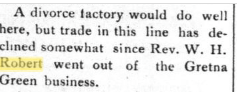
of marriage, however. On
January 27, 1889, it wrote, "A divorce
factory would do well here, but
trade in this line has declined somewhat
since Rev. W.H. Robert went
out of the Gretna Green business.”
The Sunday Gazetteer
Sunday, August
22, 1886
 The Sunday
Gazetteer
The Sunday
Gazetteer
Sunday, January 27, 1889
In
the summer of 1884 Rev. W.H. Henry, wife, and
son, W.H. Henry, Jr. and
wife, visited relatives and friends in
Centreville, Mississippi.
They returned on October 12 and a
notice in the October 21
newspaper stated that "...Rev. W.H. Robert,
formerly of this city but
now of Centreville, Mississippi...." (The
Sunday Gazetteer, October 21,
1884).
The
Sunday Gazetteer
Sunday,
July 21, 1889
pg 4
The residence of Rev. Dr. W. H.
Robert on Owings street was Monday
night the scene of a most pleasant
event. It had reached the hour of 8
p.m., and the good doctor, seated at
a window in the rear part of the
house, was deeply engrossed in the
enjoyment of the cooling southern
breeze when a knock at the front
door followed by the sound of many
footsteps in the street without,
attracted his attention. Perhaps he
thought it was a wedding party in
quest of his services. Perhaps, he
remembered hearing sounds like this
before, in the days when he was
more active in service and before he
became a city missionary.
Perhaps, a recollection that that
day was the sixty-eighth anniversary
of the day on which he first saw the
light come to him and something of
the truth was communicated through
the medium we call apprehension. But
be these conjectures true or false
he was not long in doubt as to the
identity of the invaders, or the
nature of their mission. Headed by
Rev. W. E. Tynes, pastor of the
First Baptist church, they
surrounded
the reverend doctor and
congratulations were showered
thick and
fast upon him. The the besiegers
began to unburden themselves of
their
more substantial tokens and packages
and parcels were heaped around the
doctor until they threatened to hide
him from view. After the donation
exercises were over and the reverend
elder had pocketed a purse
containing a neat sum in coin of the
realm, the party proceeded to take
possession of the premises and to
enjoy themselves enthusiastically
during the balance of the evening.
It was a late hour when the company
dispersed, all going to their homes
with pleasant recollections of the
event.
William
Henry Robert died in 1900 at Centreville,
Wilkinson Co., Mississippi.
William Henry Robert Jr. is buried in
Belton, Texas.

 "William Henry
Robert." History of the
Baptist Denomination in Georgia.
Atlanta, GA: Jas. P. Harrison &
Co., 1891
"William Henry
Robert." History of the
Baptist Denomination in Georgia.
Atlanta, GA: Jas. P. Harrison &
Co., 1891
French American Roots
Biography Index
Susan Hawkins
©2025
If
you find any of Grayson County TXGenWeb links inoperable, please send me a
message.
|