Will J.
Scott
[Source:
Francis White Johnson and Ernest William
Winkler, A
History of Texas and Texans, Volume
3 (1914), page
1111]
For
the past seven years postmaster of
Denison, Will J. Scott is one of the
citizens of that community whose long
residence, success in business, and
high personal character entitle them
to the best distinctions in public
life, and the position to which he has
been called he has rendered faithful
and intelligent service in the public
interest.
Will
J.
Scott, who is Scotch-Irish descent,
was born February 14, 1853, at
Lexington, Kentucky. He has an uncle,
Rev. Robinson Scott, who for
twenty-five years was president of the
Belfast Methodist College in Ireland,
and who left one child. Mr. Scott's
parents were William and Elizabeth C.
Scott. His father was born in Belfast,
Ireland, and his mother in Norfolk,
Virginia. They were married and came
to Kentucky in 1850, the father being
a lawyer by profession, also a farmer
and stock raiser, and had a home near
Lexington, Kentucky. Later he retired
and lived in the city of Lexington
until his death in 1860. The mother
died in 1898 while living at Denison
with her son. There were only two
children, and the older, Robert Scott
was born in 1851, and died in 1856.
Will
J.
Scott is a man of superior education,
and is a graduate of Kentucky
University at Lexington. He is a
pioneer of Denison, having lived here
since 1873, at which time the town
comprised only a collection of
business and residence houses grouped
about the railroad terminal. Mr. Scott
was one of the early pioneer
postmasters of Denison having been
appointed to the office in 1877 by
President Hays, and filling the place
for four years. Roosevelt in 1907
appointed him to the office, and by
reappointment under President Taft in
1911, he is now in his second
consecutive term, which will expire in
1915. He has always been a Republican,
and has given much effective aid to
his party in Texas and the south.
Fraternally he is affiliated with the
Benevolent and Protective Order of
Elks, belongs to the Denison
Commercial Club, and is a member of
the Episcopal church.
Mr.
Scott was married October 9, 1875, at
Denison to Miss Ella J. Jennings, a
daughter of J. W. Jennings of St.
Louis, Missouri. Her father was a
successful flour manufacturer and
lumber man in Denison for several
years and later was engaged in
railroad brokerage business at No. 1
Broadway in New York City, and his
death occurred in that city in 1909.
No children have been born to Mr. and
Mrs. Scott.
As
a Denison pioneer, Mr. Scott is
familiar with every phase in the
growth and development of this city,
and is one of the most enthusiastic
boosters of not only Denison, but of
all north Texas. He is a man of wide
acquaintance of much travel. He served
as presiding judge of the Racing
Department of the Texas State Fair for
fifteen years, and during that time
traveled all over the United States,
visiting other fairs and race meetings
in the interest of the great Dallas
attraction. Mr. Scott spends his
vacations chiefly at Asbury Park,
Atlantic City, and other eastern
resorts.
He takes great
pride in the Denison of the present day
with its twenty thousand people, with its
good banks, schools and churches, the
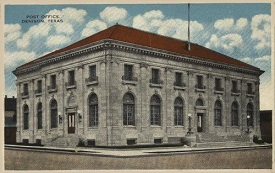
largest federal building in the South used
exclusively for post office purposes, with
various modern office buildings, a one
hundred thousand dollar high school, nine
ward school buildings, and many other
improvements which mark the progressive
character of the citizenship. A
distinction which could not be forgotten
is that Denison had the first graded
public school in Texas. Mr. Scott speaks
of various other features which are patent
in a consideration of Denison's position
in the list of Texas cities. The M. K.
& T. Railroad shops have a payroll of
$20,000 a month, and the post office
payroll will average about $110,000 a
year. One hundred and fifty postal clerks
have their headquarters in Denison which
is the division point in the railway mail
service, and for that reason the post
office has special importance in the
Southwest.