|
|
||||
|
|
||||
|
In Memory of "Grandmother" Carr
Away back yonder in bonny Scotland, there came into being a family of people to be known to the world as "the Kirkpatricks" of Scotland. After many generations had made the family into a dignified and very religious tribe, a part of it decided to come to America, and become a part of the liberty loving, free and easy citizenry of this land. And so as the years passed into history. Among the younger members of this family who had settled to make a home and fortune in Georgia was the father of Harriett Emeline Kirkpatrick Carr, in whose memory this tribute is written. This little blue-eyed girl came into the home, a welcome guest, and while she was yet a small child, the father and mother moved on to find for themselves a home, into which they might plan and find expression of their ideals of life. They were a very religious family, the father being a preacher of the Methodist faith, and a presiding elder in that church. So we see where the little Harriett received her strict training in church life.
She grew into young lady-hood under these environments--religion, romance and chivalry. In the year 1854, her father moved again to Minnesota, and 'twas there that the real romance of her life began, when she met Theron F. Carr. Theirs was a real friendship from the very beginning and has lasted through the years till last Thursday when the "tomorrow" of her life was changed into the "today" of her eternity. "Grandmother Carr" was born in July, 1842, and lived to be more than 85 years old. She, with her husband, lived through many story [stormy] days, but there were also the days that fragrant with the "roses that bloomed beside life's door." In her young lady-hood, she attended Hamlin University of Minnesota and 'twas there that she and Mr. Carr studied music together, as it were, getting the harmony of life tuned just together. 'Twas there that the rough places, and the discords, were worked over to make the melody of their paths smooth and easy. Later, they studied in what was known as "the select school" of Minnesota, studying organ music, and in July of 1861 they were married in Pine Island, Minn. Of those who attended their wedding, Mr. Carr is the only one left among the living. After they were married, they followed the example of their parents, and moved into a new part of the world to start their lives together. They selected for their homestead that lovely lake country, and picturesque. Soon their wedded bliss was disturbed by the rumors of Indian wars, and just as they were about to gather their first crops, she was left in the little home nest to care for it, while her gallant young husband went out to trail Indians. Their little log cabin became the refuge of many who came to them for shelter, while the men of the families joined in the Indian war. During these days of hardships, Mrs. Carr would spend her time molding bullets for the Indian chasers. They lost their all in the war by the burning torch of Indians, and after it was over, they moved to Missouri, and still later to Louisiana. The last years of their lives have been spent in Texas and California, back and forth they have been, to be with their children. All of their six sons and one daughter are left to testify to the nobleness of the character of the mother who has just left them. All of her life was Grandmother Carr a devout Christian character. She lived during the days when sometimes it was hard to see that the hand [of] God was guiding her destiny, but through it all, she never wavered, but held fast to the truth of her Bible., which was the strength of her being. The last few years have been hard for her, physically, but she smiled through the tears of suffering, looking forward to the "land that is fairer than day." Mrs. Carr has been a long and faithful member of the Methodist Church, and was a member also of the Order of the Eastern Star. The few weeks just past had left her in a very weakened condition, and her suffering made them around her unhappy, but her only words would be that she was tired and wanted to be at rest. The "rest" came to her quietly, and she just went to sleep in her home here, to awaken in the "home prepared for her, eternal in the heavens." She left the one who had travelled through this life with her, very sad and desolate, comfortless. But his mind is so fixed on the other "home," that the pain of parting is not very real. He is near the homeland himself, and at best, the separation is not for long, and in his child-like faith, he seems almost to hold communion with "Harriett" as of old. They had spent sixty-six years in married life, and their thoughts had become almost one. The home is sad, is all but broken up, but the sons and daughter realize that their mother was ready and anxious to "go" and their sadness is not a grief, but just a hurting in the heart, and a longing to be with "Mother." We would offer our sympathy to them, understanding the emptiness of it, for only they who have "passed under the rod" can know what the vacant chair by the fireside can mean. They long for the touch of the old withered hand, all in vain. We, too, loved "Grandmother Carr," and can only say to the ones left lonely, "We shall meet on that beautiful shore." Just one of God's children gone home!
Matagorda County
Tribune
- November 4, 1927 and reprinted in Oak Leaves |
||||
|
(Cora B. Moore)
Sometimes we want to say something which we feel very keenly, and the words just will not come. In thinking of “Grandpa” Carr this morning, he comes so vividly before us as the man he was, we are able only to see him in the very varied life which he lived so long and so well here, and in the many climes and stations where he made himself into the characteristic figure that he was.
The background of his life was one of very interesting history, his grandparents having been close personal friends of General George Washington, who was a frequent visitor in their home in New York. His grandfather was a member of that historic regiment under Gen. Washington, called “The Buck Skin Cap Brigade,” in which he fought for this land of ours.
Thus we can see that tradition may have had a deal to do in the shaping the life of Theron F. Carr from his very babyhood. He came into this world 87 years ago, in the old home in Albany, New York, where he lived as a child. The pioneering spirit was at fever heat in those days, and when he was yet a child, his family began the “westward ho” journey, which eventually carried Mr. Carr to the extreme west coast of America, even to Seattle, Washington.
Life was not a “bed of spring flowers” for the lad, for those were the days which tried men’s souls, and responsibilities were heaped upon his young shoulders. Through them all his love of beauty and harmony was ever alert and active. He found the silver lining in all his clouds, while his smiles chased the frowns away on the days otherwise gloomy.
His “sports” while a young boy were sort of drill masters for him as he grew older, and the play hours taught him the useful traits, which he brought into active service for his country. In Wisconsin, Minnesota, and in the Dakotas, he was a familiar figure as he led expedition after expedition in the war against the Indians. During these tempestuous times, Theron Carr and Harriet Kirkpatrick, from the old Scotch family of Georgia, were married. There was all of the romance of those days in their love, courtship and marriage. They were attending the same college, studying the same music, and at the same time, learning harmony of “soul” which was not a course given in the curriculum.
After their marriage in 1861 came the war with the Indians, and thrilling were the experiences that came to them. Mrs. Carr and her home served as kind of “fort” for the wives of the other soldier boys, and she taught them the art of bullet making, which their young husbands used in those queer looking guns.
We have see “Grandpa” Carr so far, as student, farmer and soldier. Next he decides to move toward the Southland, and we see him in Kansas and Missouri as a merchant, railroad man and leader in civic work as mayor of a Missouri town. The roving spirit was still upon them, and to Louisiana they came. There Mr. Carr was contractor for a long stretch of railroad construction, after which he operated the telegraph key very successfully. All during these years he was teaching music at odd times, principally at night. He served as pipe organist in one of the city churches where he lived. ( Mrs. Carr could play for him when he was otherwise engaged, you see.)
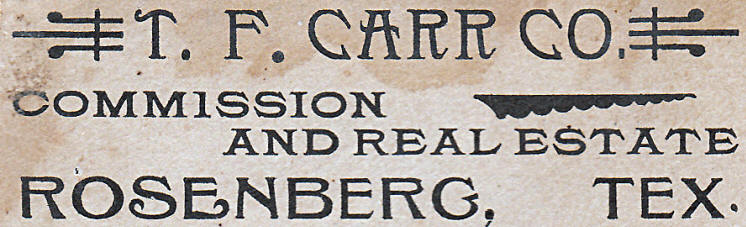
The next move brought the Carr family to Texas where their home has been for most of the time. Over in the Rosenberg country Mr. Carr owned and operated a large plantation, and the Methodist church in Rosenberg now stands on the plot of ground given by him to the church. A few of these latter years have been spent in California and Washington on the West coast, but Texas has been the real home of the couple in their advancing age.
Such has been the varied experiences of that great and good man, Mr. Theron F. Carr.
He was associated with many men of note. At one time, he lived in the “Main Street” made famous by Sinclair Lewis. He and Dr. John Sloan, of the yesterday of Bay City, attended the same university. He was a close personal friend of Robert Morris, founder of the Order of the Eastern Star, and he took his Masonic degrees under some high up personage whose name I cannot recall just this minute.
You wonder how I know all of these interesting things? I had the privilege of calling Mr. Carr my friend, and many, many days he has been to see me, and I proved myself a good conversationalist by listening most intently to his wonderful experiences, as he would sit and “reminisce” to me. He has shown me photographs of things in which he was interested, the Indian war, particularly. His experiences read like fiction, and we have talked many times of trying to arrange some of them into magazine shape, but “procrastination” has made it all too late.
Mr. And Mrs. Carr lived their last days among us, and it was always a pleasure to visit with them, because time never lagged when with them. All of their days were not happy ones, but all of these days served to make their lives full and colorful. Their sorrows made their joys sweeter, while their joys softened their sorrows and made life richer. The whole Carr family reflect the companionship which was enjoyed in that home, and that is on place where we appreciate the “clan” spirit, a spirit which was brought into play by the old Scotch home making mother, as was inculcated in the life of Grand Mother Carr by her ancestors of the long ago.
It was the sweet privilege of the daughter of the family, Miss Fay, to be the companion and solace of their last days, and how well she performed her duty can only be mentioned, never realized, for her whole life and thought, was “Mother and Dad.” I think I have never seen a more beautiful devotion than that shown by Miss Fay to her parents, and I am very sure that their lives were prolonged by her unselfish attention, day and night, to them. She seemed to hold them by the sheer strength of her will power over them.
And the life of this good man is over. A small marble stone will mark his resting place, close beside his “Hattie,” but his life will live on in those with whom he came in daily contact. All through his life Mr. Carr has been a student of music, and the last talk I had with him, he was planning to organize a “harp” club here in Bay City, never dreaming that the “first of the year” (as his plans were) he would be playing on his harp in the heavenly club. This talk was during his last day out, Christmas Eve, and the fever caught him, from which he had not strength to rally.
There is sorrow in the home since he is gone, but there is no grief, for “Grandpa” Carr had lived his life, his work was done, and he has only gone on “to the home prepared for him, eternal in the heavens.” During his life, he was never the robust man that we see other men being, but his frail body was no exponent of a frail mind, for the good that came from his righteous thinking will never be measured here, but results will tell of his influence while here.
Mr. Carr filled almost every sphere of life, except the pulpit, and I am not so sure that he was not a good preacher, for he has made many, many “experimental” speeches, some of which might very safely be called sermons, so we see him as he filled life’s sphere, as a “man,” doing his bit the best he could all of the way.
I am happy to have had the privilege of his friendship and confidence and am sure that my life has been made richer by the association, and so as friends together, we all are saddened by his going, but glad when we think of the happy reunions he is enjoying today, “over there.” Just another good man gone home. His face was ever toward the light, and his shadow lay behind him, as he placed his feet in the trail which leads toward the West,” January 1, 1929.
The Daily Tribune January 19, 1929
Submitted by Kenneth L. Thames |
||||
 Courtesy of Jim Wright |
||||
 Courtesy of Jim Wright |
||||
|
|
||||
|
A native of Alabama, Ida came to Texas when she
was 3 years old. Her father had preceded the family, and after he
had been here for 18 months he sent for his wife and the
children--10 of them. The train was mistakenly routed by Austin, and
there the mother and children had to stay in a hotel for a week
until they could go by stagecoach to Luling, then to their new home
near Prairie Lea, on the Guadalupe River. The children walked two
miles each day to school, but in especially bad weather they rode
horseback. There were no "grades" in school then. They simply went
from the first to the second to the third reader, and so on; and
when they finished all the readers, they progressed into History. In
the summer time, everybody attended "Camp Meetings." It didn't make
any difference, really, which denomination was holding the meeting;
they went to them all. Ida was converted during one of them, and she
is a Methodist, but she has a great tolerance and respect for other
churches.
When she was fourteen her mother died, and Ida
came to live with her brother in Wharton. He was the most wonderful
brother in the world, she said. No one could have been kinder or
more considerate than he was to her. She had learned to cook before
she was 12 years old, and now she took over the cooking duties in
his house. It was a snap, she laughed. After all she'd cooked as
many as 150 biscuits at a meal; she was regular "Pro!"
Her brother moved to Rosenberg, and here it was
that Ida met her fate in the person of Frank Carr. She had gone for
a walk; and, crossing the boardwalk from the Hotel to the depot, was
the "cutest boy she'd ever seen in her life." He went into the
drugstore, and Ida ran to drag a girlfriend from her house. "Hurry!"
she told her. "We have to buy some aspirins at the drugstore!"
(Girls were pretty resourceful even way back then, weren't they?!)
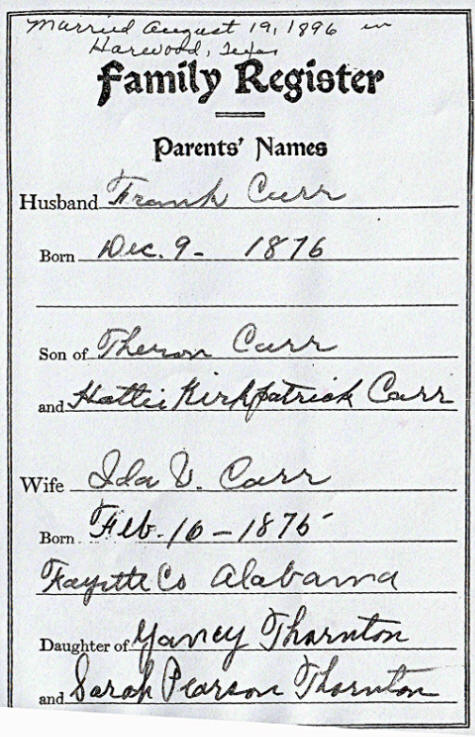
Anyway, it worked! Frank sent a note asking if he could call. And in
August, dressed in a pretty gray suit and gray hat, Ida Thornton
married that "cute boy," and Mr. and Mrs. Frank Carr settled down to
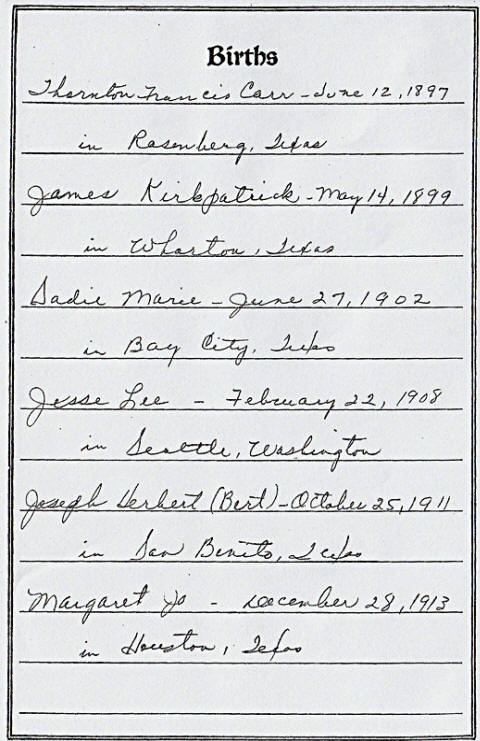
housekeeping in Rosenberg. Their first child was born here, and they
named him Thornton, though no one ever called him anything except
Tony, his mother said.
The second son, Jim, was born after the family
moved to Wharton; and in 1901 the Carrs came to Bay City. This has
been HOME ever since. True, they all went off to Seattle,
Washington, in 1907, because stories came back that money was so
plentiful there you "could almost pick dollars off trees.”
The stories were just that – stories – and Ida
hated the place. Her third son, Jesse Lee, was born here, but was
late in making his appearance, and she says she did not blame him at
all. "After all, who wanted to come into the world out THERE?" The
next son, Bert, was born in San Benito, after the Carrs had come
back to Texas. There was a daughter, Marie, who only lived for 3 1/2
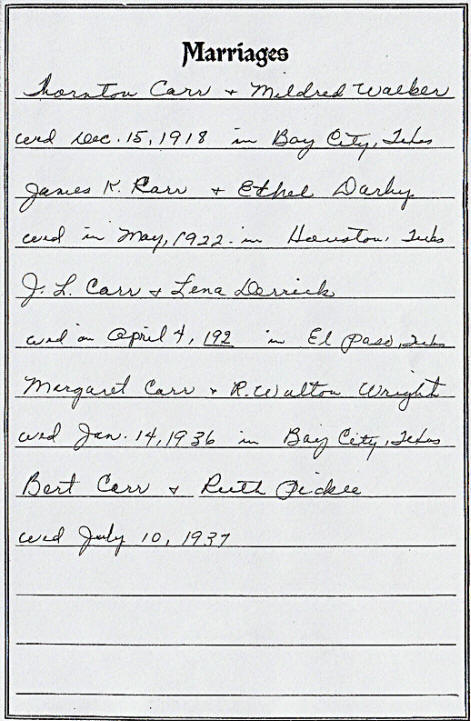
years. And there is a daughter, Margaret, who is married to Walton
Wright and lives in New Orleans. Ida's eyes grew warm as she spoke
of Margaret. The best daughter ever, she said.
Frank Carr was Deputy Sheriff while they lived in
San Benito, and the family had the first automobile in town; a Ford,
of course, a "one- seater." They were right proud of that car. After
they came back to Bay City, Mr. Carr was Sheriff of Matagorda
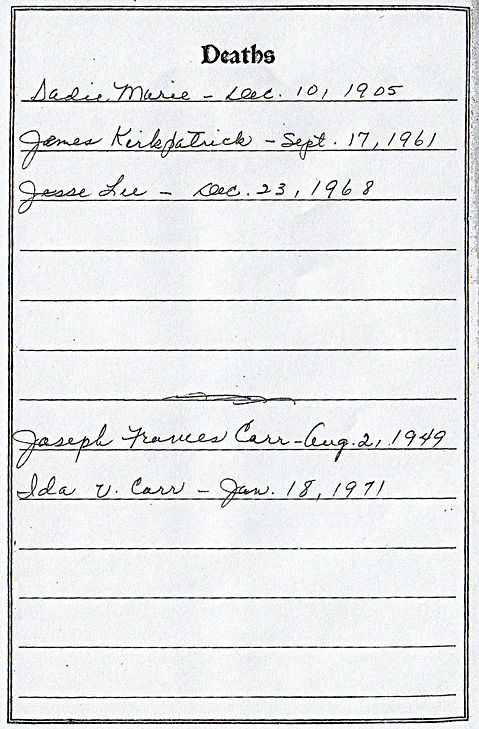
County. He died in 1949. But before his death the Carrs had been
honored by their children at a 50th Wedding Anniversary Celebration,
at the Bay-Tex Hotel. They had the best time, Ida exclaimed. So many
of the kin-folks were there, and she "loves her kin- folks." And,
she added, with a twinkle in her eye, "even an old boy friend turned
up for the occasion!"
Ida Carr is a remarkable person. Her memory is
phenomenal; her cheerfulness is genuine; her laughter is infectious.
But if one were called on to describe her in a word, that word would
perhaps be "strength." Strength of character, of purpose, of faith.
She has a firm conviction that the Lord is in control, and a serene
confidence in His guidance. So Ida Carr can sit back and enjoy the
good things in her life with the knowledge that life has been well
spent. She counts her blessings gratefully. It's doubtful if she
could ever be convinced of the blessing she herself has been in the
lives of so many people. The world sadly needs such as Ida Carr. May
her tribe increase.
Daily Tribune, July 22, 1968 |
||||
| Pearson, Thornton, Walker, Darby, Derrick, Wright, Pickle |
 “The nicest feeling in the world is to know
you're wanted," Ida Carr said, "and I've never been happier in my
life than I am now." When Iris Darby ("they don't come any finer
than Iris," Ida says) wrote her and urged, "Please come and live
with me, Rosa and I need you,'' she was establishing the very
pleasant and congenial household at 1304 Sixth Street. Ida Carr has
seen a lot of living -- and now, at 93 years of age, she is content
to spend her days quietly with her TV, her reading, (she has to use
a magnifying glass sometimes), and her visiting with friends. Her
interest in what's going on has not abated one whit; she is spry and
energetic enough to put a teen-ager to shame; and her wit and humor
are downright delightful. She's a living doll, this girl. Go visit
her for an afternoon you won't forget. But have plenty of time when
you go. You won't want to leave!
“The nicest feeling in the world is to know
you're wanted," Ida Carr said, "and I've never been happier in my
life than I am now." When Iris Darby ("they don't come any finer
than Iris," Ida says) wrote her and urged, "Please come and live
with me, Rosa and I need you,'' she was establishing the very
pleasant and congenial household at 1304 Sixth Street. Ida Carr has
seen a lot of living -- and now, at 93 years of age, she is content
to spend her days quietly with her TV, her reading, (she has to use
a magnifying glass sometimes), and her visiting with friends. Her
interest in what's going on has not abated one whit; she is spry and
energetic enough to put a teen-ager to shame; and her wit and humor
are downright delightful. She's a living doll, this girl. Go visit
her for an afternoon you won't forget. But have plenty of time when
you go. You won't want to leave!