|
To
paraphrase Winston Churchill, Ruffus has been a riddle wrapped in a
mystery inside an enigma.
Interest
in him dates back to 1992 when Kenneth Thames started researching all
the known veterans buried at
Cedarvale
Cemetery
for Philip H. Parker VFW Post
2438,
Bay City
which had adopted the cemetery
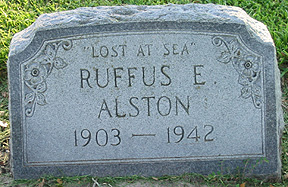
as their own. His marker located in Section Four simply states Ruffus E.
Alston, 1903 – 1942, with an inscription across the top that reads
“Lost at Sea." So who was Ruffus? Was he a Navy man? Was he a
soldier who went down on a troop transport – was he Merchant Marine
– or was he a shrimper or tug boat employee?
Initial
investigation found no death certificate, birth certificate or newspaper
obituary. It was decided to go ahead and list him as a veteran until
such time it was proven otherwise, and he was carried on the Post list
of veterans since that time.
Things
sort of just rode along for a while without too much research going on.
Then in June, 2000, Carol Sue Gibbs and Kenneth joined forces and began
to really look in earnest into who Ruffus was. Their research has gone
from
Bay City
to
Corpus Christi
to Floresville in
Wilson
County
. Carol Sue has collected
newspaper articles from the Tribune,
the Quincy Patriot Ledger from
The Thomas Crane Library in
Quincy
,
MA
, The New York Times from The Victoria College Library, The
Washington Sun from the Library of Congress; and from the internet,
she was also able to obtain news items from The
Morning Post from
Camden
,
NJ
. Kenneth has made field trips
to
Corpus Christi
and Floresville.
Who
was Ruffus? The genealogy room at the library started to give a few
small clues – he had applied for a delayed birth certificate on
December 27, 1941
, in
Wilson
County
– we had a start. We also
had the cemetery property card for the lot where his stone was – there
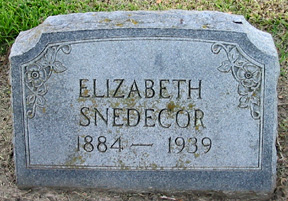
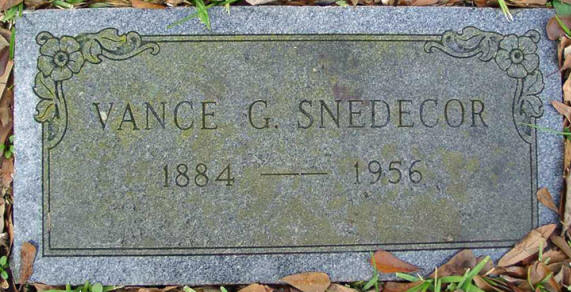
was Elizabeth Snedecor, V. G. Snedecor, I. G. Stribbling and Aaron and
Audry Fondon. Were any of these folks related? If so, did they have any
children living in this area? Four different family members were called
and two could give a few clues. They knew Ruffus had died in WWII when
his ship went down, but they didn’t know when, where or how.
What
started our research in the Merchant Marines? The real break occurred
when Lynna Kay Shuffield, a military researcher, was contacted by email
for help. She provided the information from the Merchant Marine book
entitled A Careless Word, A
Needless Sinking, which listed Ruffus Alston as a messman aboard the
SS India Arrow.
From
the clue provided by Lynna Kay, information was collected about the
construction of the ship Ruffus was on when it was sunk, the SS
India Arrow. We learned the German U boat, U-103, sank the ship, and
we learned how the ship died in flames with 26 lost souls and only 12
survivors. Ruffus was a veteran after all. Merchant Marine seamen who
had served between 1941 and 1946 had been given veteran status. Those
still living can receive veteran’s benefits if they apply for either
an Army or Coast Guard discharge.
The
Matagorda County Genealogical Society ordered a set of the fiche, All
WWII Dead, for the genealogy room of the Bay City Public Library. It
lists all the casualties of WWII. This included all the combat branches
plus the Merchant Marines – and Ruffus was listed as a member of the
Merchant Marines. His Z number 9 (service number) was part of the
information.
On
Memorial Day 2001, a flag was placed by the marker of Ruffus Alston for
the first time since he had given his life for his country in 1942. A
special sign that included a picture of the
US
flag and eagle and more
information about Ruffus was also placed on his grave as it was for
other KIAs and POWs buried in
Cedarvale
Cemetery
.
The
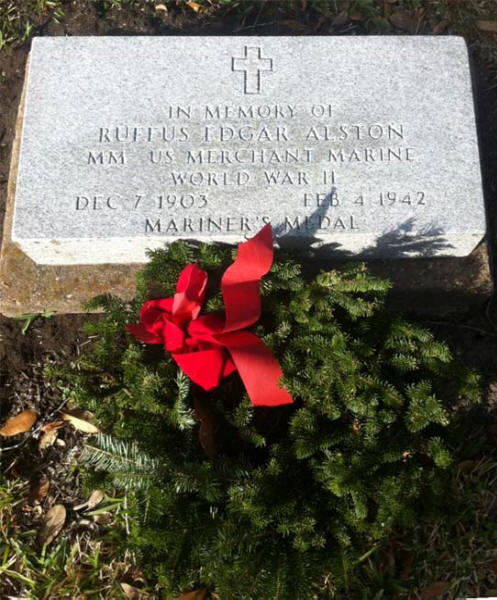
next step was to submit a request for a government monument to place at
the foot of Ruffus’ empty grave. The monument was received in November
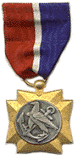
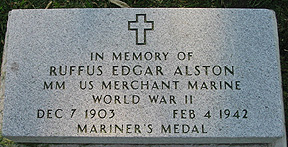
2002. “Mariner’s Medal” was engraved on it, which is the Merchant
Marine equivalent of the Purple Heart. A Presidential Memorial
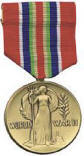
Certificate was also obtained and Kenneth is now doing research on
acquiring his medals so a small display can be constructed at the VFW in
his honor.
This
is a basic biographical sketch of Ruffus:
Ruffus Edgar Alston
was born in Stockdale, Wilson County, Texas on
December 7, 1903
. He was the first child of
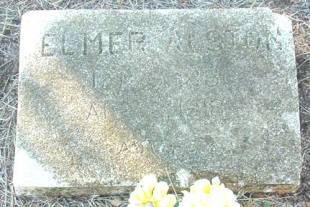
Elmer Boyd and Elizabeth Cone Alston. His father was farming in
Wilson
County
at the time of Ruffus’
birth. The family moved to
Matagorda County
,
Texas
, before
June 21, 1906
, as the next three children,
John Louis, Zelda and Melba were all born in
Matagorda
County
.
Elmer
Alston was killed in April, 1918 and his remains were taken back to
Stockdale for burial. The 1920 census reveals that Elizabeth and the
four children were living in Clemville (
Matagorda
County
) at that time. Ral Cone,
Elizabeth
’s brother, was living with
them and was evidently working in the Clemville oil field. Another
brother, Embrey, and his family were living nearby.
Mrs.
Alston was later married to V. G. Snedecor. She died on or near
September 1, 1939
, and was buried at
Cedarvale
Cemetery
in
Bay City
,
Matagorda County
,
Texas
(Section 4, Block 132). One of
Ruffus’ cousins indicated that Ruffus had lived with his mother, and
after her death he drifted from job to job.
His
sister, Zelda, had married a man from Matagorda named Ira Guy Stribling.
They were evidently living in
Corpus Christi
when the Japanese bombed
Pearl Harbor
on Ruffus’ 38th birthday -
December 7, 1941
. Ruffus went back to Wilson
County, Texas, and filed a delayed birth certificate on
December 27, 1941
, which he would need to join
the Merchant Marines.
It
is not known exactly when he joined the Merchant Marines. He listed his
sister Zelda as his next of kin. His service number was 241522.
He
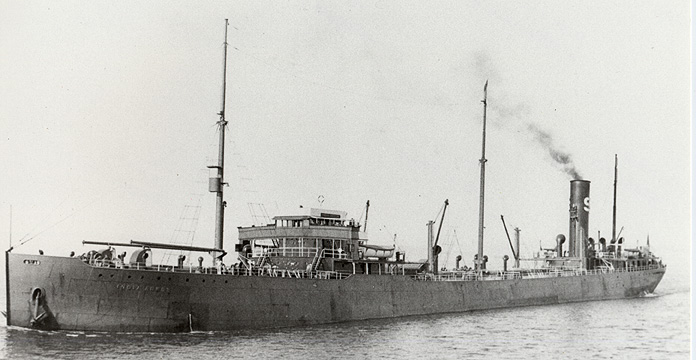
joined the crew of the SS India Arrow, an 8,327-ton oil tanker
owned by SOCONY [Standard Oil Company of New York]-Vacuum Oil
Corporation, today Mobil Oil Company, at Corpus Christi as a messman in
the galley. With a crew of 38, the ship sailed from
Corpus Christi
enroute to
Cateret
,
New Jersey
, carrying a cargo of diesel
oil. The India Arrow was unescorted, unarmed and steering a
non-evasive course on
February 4, 1942
, when it was torpedoed at
7 PM
by Nazi U Boat 103, captained
by K.Kpt. Werner Winter, approximately 63 miles southeast of
Cape May,
New Jersey. The torpedo struck the ship
in its starboard quarter, exploding in the engine room. The ship
immediately burst into flames and sank within five minutes. Before the
ship could sink, K.Kpt. Winter had his submarine surface and commenced
lobbing shells into the burning tanker, hastening its demise. He made no
attempt to rescue any of the survivors. Only one lifeboat was successful
in getting away from the burning ship, and of the 38 crewmen onboard,
only 12 survived the attack. It is unknown if Ruffus died in the burning
oil that was floating on the sea or if he went down with the ship. His
remains were never recovered.
This
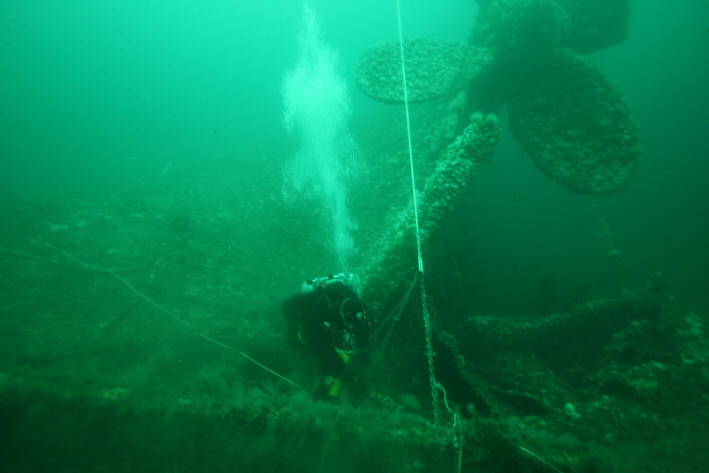
photograph of the India Arrow was taken Saturday, July 14, 2007 by Paul Whittaker. It pictures the upside down fantail (stern) of the
India
Arrow with the prop visible in the background. Diver, Harold Moyers, is
tying in an anchor line to a fishing scallop dredge that the wreck has
collected. The water even at 192 feet is blue and clear, and the wreck
is majestic.
To those of us who respectfully visit these places, we think the
graveyards at sea are far more beautiful then those on land.
--Harold Moyers
26
ON TANKER LOST AS U-BOAT STRIKES; 12 ADRIFT 36 HOURS
The
India
Arrow Sinks in an Inferno of
Blazing Oil, the Twelfth in
U.S.
Waters
SHIPS
IGNORE SURVIVORS
Wary
of Attack, They Refuse to Answer Signal—
London
Views Situation Gravely
In a grim
continuation of the warfare that already has claimed thirteen announced
victims in
United States
waters, another American
tanker has been picked off by an enemy U-boat operating off the
New Jersey
coast. Twenty-six of her crew
of thirty-eight are missing, the Navy Department disclosed yesterday.
The
8,327-ton tanker India Arrow sank in a sea of blazing oil after
she had been torpedoed and shelled by a submarine that struck without a
second’s warning early Wednesday evening. The twelve survivors, picked
up by a fishing boat, were brought into
Atlantic City
yesterday morning after
spending two nights and a day in a wave-tossed lifeboat.
The
ship, owned by the Socony-Vacuum Oil Company,
New York City
, was the twelfth sunk and the
thirteenth attacked in American waters since Jan. 14, according to Navy
announcements. In addition, a dispatch from an Eastern Canadian port
last night told of the landing of survivors from torpedoed British
tanker, the fifth sinking off the Canadian coast that has been revealed
during the same period. This brings the known total of U-boat victims
off the Canadian-American coast to eighteen in all.
London
Takes Grave View
The seriousness of
the situation on this side of the
Atlantic
was emphasized yesterday in an
official disclosure from
London
. Declaring that sinkings in
the
Battle
of the
Atlantic
, including the American
victims, had gone up sharply, the official sources asserted that a
considerable portion of the Nazi U-boat pack undoubtedly was hunting off
the
United States
coast and that there
unquestionably “are more U-boats operating in the
Western Atlantic
that ever before.”
Landing
in
Atlantic City
after their harrowing
experience, the captain and eleven others of the India Arrow’s crew
revealed a new horror of the submarine warfare in home waters. Their
stories indicated that prevalence of enemy raiders apparently has made
merchant ships extremely wary of all signals, and it has become
increasingly difficult for survivors of a sunken ship to reach a rescue
ship at night. Several times during the black hours of the first night
out, the men from the India Arrow had the heart-rending experience of
sighting ships that might have rescued them, but, according to one of
the survivors, they all steered clear when the lifeboat’s crew
signaled with flashlights.
Captain
Johnson, a gray-haired, 48-year-old sea veteran, told how one lifeboat
jammed with officers and seamen went down when debris from the ship’s
shelled bridge struck it. He soberly said: “I am doubtful if any
others survived
Bringing
Oil Here
The India
Arrow, a 468.3-foot tanker, built in 1921 at
Quincy
,
Mass.
, was sailing from
Corpus Christi
,
Texas
, to her home
port
of
New York City
with a cargo of oil when the
torpedo struck her at
7 o’clock
Wednesday evening. Her exact
location off the
New Jersey
coast was not revealed in the
Navy announcement.
Captain
Johnson, who lives at New Dorp,
S. I.
, with his wife and three young
children, told the story of how it happened.
“I
was on the bridge,” he said. “There was a loud report, and the
torpedo slammed into the starboard side, to the fore of the engines. The
ship caught fire and started sinking in about 5 minutes. Oil from the
No. 10 cargo tank, which was punctured, leaked onto the water and caught
fire, too.”
The
ship started to list, the shelling from the submarine’s deck gun
began, the bridge collapsed and the captain fell off the bridge he
related. Almost miraculously, he was “washed into a lifeboat” that
had been launched successfully from the starboard side—he still is now
sure how it happened. Two other men were in the boat.
Two
lifeboats were lost when the ship’s stern went under, and the bulk of
the Indian Arrow’s crew rushed for the remaining port lifeboat.
When the shelling began and the bridge collapsed, the debris struck this
boat, survivors related, and the screaming, cursing men were knocked
into the water—most of them to their death.
“The
blaze lit up the scene, and we could see the conning tower of the
submarine on the other side of the burning boat,” Radio Operator
Edward J. Shear related. “We were afraid to do anything—to show our
lights, to set sail or start rowing or even to bail out the water that
had shipped into the lifeboat—because we thought the sub might start
shelling us. We were only 300 yards away.
Oil
Blazing on Water
Captain
Johnson continued with the story of how the lifeboat drifted around,
finally managing to pick up nine other survivors within an hour after
they had taken to the water. No others were to be found by then so they
finally put up the emergency sail that the lifeboat carried and,
augmenting it with work at the oars, started pulling away. They could
see oil blazing on the water for nearly two hours afterward. Much later,
they could see in the distance the tantalizing spectacle of lights from
Atlantic City
and other resorts.
Radio
Operator Shear, 27-year-old native of
Port Arthur
,
Texas
, told how he was reading in
his room when the torpedo struck.
“I
ran to the radio room and sent out the signal that we were torpedoed,”
he said, “I tried to send our last-known position but before I could
do so the lights failed. I tried the emergency power and it was useless.
I ran to my cabin, got a lifebelt and my flashlight and made a lifeboat
just in time.”
It
was the radio operator who told how the survivors in the lifeboat
flashed their lights at ships that passed them in the night.
“All
they did was change their courses,” he said.
Captains
of coastal ships are reportedly wary of signals since one of the
previous
Atlantic
Coast
victims was lured to her fate
by a false signal from a submarine that posed as a lightship.
Bitter
disappointment followed the next day when not a ship was sighted, Shear
continued.
One
of Luckiest Aboard
Michael Kusy, who
lives at
430 East Seventy-second Street
,
New York City
, with his parents, Mr. and
Mrs. Emerich Kusy, considered himself one of the luckiest men aboard the
India Arrow. He tried to get in the port lifeboat but it was
filled up, so he jumped in the water and grabbed a hatch cover.
“I
saw the port boat go under when the bridge hit it and was thankful I
wasn’t in it,” he said.
He
was picked up thirty minutes later by the other lifeboat, but had a few
bad moments in the water when he first sighted it. He yelled but could
not make himself heard, so, using all of his strength, he paddled his
hatch cover over to it.
Three
other “lucky” men were Gordon Chambers, 20, of the
Bronx
, a wiper; Norman K. Baugh, a
20-year-old ordinary seaman from
New York
State
, and Fred H. Baker, 22,
machinist, of John’s
Island
,
S.C.
Baker had been in the crushed
port lifeboat but had managed to keep afloat until rescued. Chambers and
Baugh were the last two men to be picked up by the captain’s boat.
They hung on to debris in the water for an hour before they were
rescued.
It
was not until
6:30 A.M.
yesterday that the survivors
of the India Arrow were picked up by Frank D. Marshall, skipper
of the fishing boat Gitana, out of
Atlantic City
. The 60-year-old fisherman and
his mate, John Shaw, 35, were twenty miles southwest of the
Atlantic City
light when they saw a light
about a mile away. They kept going and soon they saw the lifeboat.
Marshall
told how one of the men in the
lifeboat yelled that they were from torpedoed tanker, and asked if they
could have a tow.
“Tow,
hell!”
Marshall
shouted back, “Get
aboard!”
They
were a sorry looking crew, he related—soaked with oil and water, and
most of them barefooted. They had had nothing to eat but oily biscuits,
and oil from the torpedoed tanker had ruined the drinking water.
Marshall
brought the survivors in to
the Coast Guard station at
Atlantic City
. There they got baths,
first-aid, steaming breakfasts and beds, while the Red Cross rushed over
with warm clothes. The captain was suffering a little from an injured
ankle, and Edward J. Proehl, a
Jersey City
seaman, was a victim of shock
and exposure. Otherwise the survivors were all right, and almost to a
man they echoed the sentiment of Captain Johnson, who declared: “I’m
ready to ship again.”
LIST
OF
INDIA
ARROW CREW
Tanker’s
Owners Reveal Names of 26 Missing in Disaster
The
Navy Department listed the following men as rescued when the 8,327-ton
American tanker India Arrow was torpedoed off the
New Jersey
coast:
Captain
Carl S. Johnson,
34 Vincent Avenue
, New Dorp, S. I.
Edward
J. Shear, radio operator,
Port Arthur
,
Texas
.
Dale
L. Montgomery, boatswain,
Inglewood
,
Calif.
Charles
L. Seerveld, able-bodied seaman, Center Moriches, L. I.
Michael
C. Kusy, able-bodied seaman,
430 East Seventy-second Street
,
New York City
.
Edward
J. Proehl, ordinary seaman,
Jersey City
, N. J.
Norman
K. Baugh, ordinary seaman,
New York
State
.
Fred
H. Baker, machinist, John’s
Island
, S. C.
Alvin
C. Bradford, fireman,
Pine Bluff
,
Ark.
Bertram
F. Palmer, fireman,
Sayville
, L. I.
Gordon
Chambers, wiper, the
Bronx
.
Sam
Colquitt, messman,
Madisonville
,
Texas
. (Colquitt is carried on the
crew list of the Socony-Vacuum Oil Company, owner of the ship, as Walter
Colquitt.)
Twenty-six
men are missing in the disaster. Their names, released by Socony-Vacuum,
are:
Joseph
T. Davis, chief officer, the
Bronx
.
Arthur
L. Brouillet, second officer,
Holyoke
,
Mass.
James
J. Winn, third officer,
Brighton
,
Mass.
Eric
Suderow, chief engineer,
New Brighton
, S. I.
Thomas
E. Brittingham, first assistant engineer,
Freeport
, L. I.
Walter
V. White, second assistant engineer, Tottenville, S. I.
George
D. Truitt, third assistant engineer,
New York City
.
Stanton
P. Heater, junior third assistant engineer,
Cleveland
,
Ohio
.
James
S. Kerr, able-bodied seaman, Arkabutla, Miss.
Edward
P. Simonson, able-bodied seaman,
Philadelphia
.
Robert
Tucker, able-bodied seaman,
Riverside
, R. I.
Ernest
Baldwin, able-bodied seaman,
Huntington Station
, N. Y.
Michael
Schwartz, ordinary seaman,
Brooklyn
.
Harris
Ellinekas, pumpman,
New York City
.
Anthony
Simon, oiler,
Scranton
,
Pa.
Henry
J. Moody, oiler,
Beaumont
,
Texas
.
Joseph
B. Anger, oiler,
Port Arthur
,
Texas
.
Victor
M. Armanini, fireman, Beaumont.
Oliver
LeJeune, wiper,
Frisco
,
La.
Ira
H. Duhrman, wiper,
Baltimore
,
Md.
Karl
Huhnergarth, steward,
Hoboken
, N. J.
Thomas
E. Harris, chief cook,
Port Arthur
.
Thomas
Nilsen, second cook,
Brooklyn
.
Michael
A. Finn, messman,
New York City
.
Nicholas
Hetz, galley assistant,
Camden
, N. J.
Rufus
Alston, messman, Corpus Christi,
Texas
.
The
New York Times,
Saturday, February 7, 1942
:
|