The
Bushwhacker
Part I of II
By: Dusty Williams
One
cannot mention the term “western” and not
think within the first few seconds, “Josey
Wales.” A classic film with the famed, Mr.
Eastwood, creates for a legacy in the media
market that will continue to speak to people,
especially those of the south. However, the
tale of Josey Wales connects more with north
Texas, Van Alstyne in particular, than many of
us may know.
Some
sources state that the story of Josey Wales
was written and based upon the life of
Bushwhacker William “Bill” Wilson. He was
referred to as “The Bushwhacker” or “The Great
Bushwhacker.” He was most probably the most
notorious of all other men like him. Some say
he ran with men like Quantrill, Jesse James,
The Younger gang, Dick Kitchen and Anthony
Wright and it is said that when he was with
them he was in charge, leading all of
Quantrill’s men on several occasions, this
according to a 1938 biography written about
him.
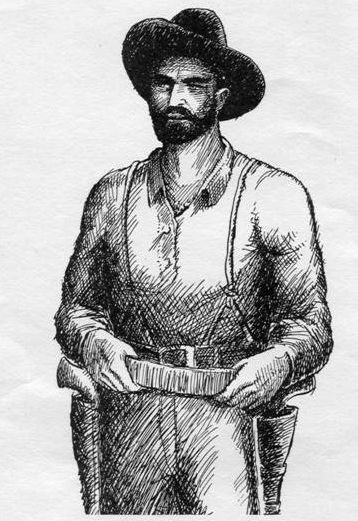
Bill Wilson
Born
around the year 1830, he was a native to
Phelps County, Missouri, an area deep within
the Ozarks. Before the war he had been married
and throughout his life, no matter what he was
doing, he remained a family man to his four
children and wife. He stood six feet, two
inches and weighed 185 pounds with thick locks
of black curly hair. Light skinned and light
blue eyes, he normally wore a short beard. He
was charismatic and enjoyed playing the violin
at local get-togethers. He remarked that his
three best friends were his two 44’s and his
horse. A classic countryman, he had two known
horses. The first was called “Dime” because
the horse had a dime shape on its forehead.
When the horse went lame, The Bushwhacker set
him free to the hills and he could be seen
from time to time. The other faithful
companion was a horse named, “Bullet” – named
so for his incredible speed. He was a
well-trained horse, as all of Wilson’s horses
were, and would come to Bill the moment he
whistled.
Bill
and his three friends roamed the Ozarks
throughout the Civil War making terror for the
Union and Red Legs whenever they could.
Originally Bill, like his home state of
Missouri, was neutral and chose neither the
Union nor Confederate. After being wrongly
accused of horse theft, his family was thrown
from their house while he was away and the
structure was set afire. From this moment on,
Bill made it his goal to make hell for the
Government and Union forces. Keeping to the
hills he would see his family and friends when
he was able and did what he could to help
them, all the while leaving the bodies of
Unionist and spies across the countryside. So
good a marksman was he that it is said he
would draw out his double 44’s while amount
and charge toward a tree, firing at it as he
went around it. When he was done, there was a
perfect ring around the tree from his target
practice. These rings were found around trees
long after his disappearance.
After
the war, Missouri was still full of unrest and
bodies continued to emerge throughout the
area. The great cleanup of Bushwhackers came
in 1868. Bill moved his family to a new piece
of land nearby and bid them farewell as he
headed for Texas. There are not many accounts
as to what Bill did over the next year,
however if he had rode with Quantrill and his
men at other times, it is likely he came to
Sherman where some of these men were known to
have resided. Grayson County was full of
Missouri migrants, especially during this time
period.
Recently,
a story has emerged that Bill Wilson was
murdered near Van Alsyne and buried in a
shallow grave somewhere nearby. The McKinney
Examiner reported to the Galveston Flakes
Daily Bulletin on February 7, 1869 as
follows: “Horrible
murder and robbery of a Missourian - One of
the foulest murders and robberies in the
annals of crime was committed on last Sunday
evening in the southern portion of Grayson
County, a few miles north of Mantua in this
county, a stranger from North Missouri,
entirely unknown in this section, being the
victim, whose name is yet a mystery.” The Georgetown
Watchman reported on April 17, 1869
that “On the discovery of the body of the
murdered Wilson, great excitement prevailed on
the suspicion falling on the two men,
Blackmore and Thompson.”
Accounts
state that Mr. Wilson was driving to McKinney
with a wagon load of apples which he sold. At
the drug store of Foote & Herndon Wilson
exchanged gold for currency, a total of $600.
It was revealed later, in some newspaper
accounts, that Blackmore and Thompson were
preparing to rob the drug store, however when
they witnessed the before mentioned
transaction they decided to take their chances
in robbing Wilson. Mr. Wilson headed back
north and stayed the night with Col. Wilmeth.
The next day he continued north and was gunned
down by the two men north of Mantua near
present day, Van Alstyne. Some reports state
that Wilson had seven bullet holes, supposedly
all that entered him through his back, while
other accounts state there were only two
gunshot wounds, one in the head and one in the
right side.
The
Galveston Flakes continued by
saying: “The firing, which occurred between
two and three o’clock in the afternoon was
heard throughout the neighborhood, and the
body of the murdered man was found off the
main road about a quarter of a mile, just
before sundown. His saddle-bags, memoranda
book and all his money had been carried off
by the murderers. Citizens to the number of
two or three hundred were summoned to the
spot, and everyone was required under oath
to prove his whereabouts on Sunday, at the
hour of the shooting was heard, but this
through investigation failed to throw any
light on the track of the murderers.
Determined to bring the perpetrators of so
foul a murder to justice, scouts were sent
in various directions. Two young men named
Wm. Blackmore, formerly of Carroll County,
Missouri, and John Thompson, formerly of
Barry County, Missouri, were arrested and
they are now lodged in jail at this place
(McKinney), awaiting an examination on the
charge of murdering the traveler. The
murdered man is supposed to have had with
him between $2500 and $3500 in gold and
currency.”

