

Wales (sometimes spelled "Whales" in early records) is a charming, rambling 18th-century frame plantation house located about three and one-half miles east of Sutherland, Virginia, on the south side of and 1/4 mile from Cox Road (about five miles west of Petersburg along U.S. Route 460). This historic home exemplifies the architectural and cultural heritage of early Virginia planters, with ties to prominent local families like Jones and Briggs, and the region's agricultural roots in tobacco farming along the Appomattox River.
The origins of Wales trace back to the Jones family, proud of their Welsh descent, who likely named the farm. Peter Jones (d. c. 1681) arrived in the area as early as 1652, serving as an officer under Abraham Wood. He married Wood's daughter Margaret and expanded trade and land holdings. Peter Jones II (d. 1726) and his brother laid out Petersburg in 1732. It is possible that Peter Jones II or his son Frederick built the initial house before 1732.
In 1732, Gary Briggs (likely Gray Briggs, ca. 1731-1807) purchased the property from a man named Jones, a native of Wales—hence the name. The main part of the house was already considered old at that time, with one room having been used as a sheep fold. Wings were added in 1752, expanding it into a distinctive five-part structure.
Howell Briggs (1709–1775), father of Gray, was a militia captain, magistrate, and vestryman. Gray Briggs, born at Wales, served in the House of Burgesses for Sussex County (1752–1758), as vestryman of Bath Parish, and later as state attorney for Dinwiddie in 1789. He retired to Wales and died there in 1807. In 1782, Gray owned 43 slaves, 16 horses, 43 cattle, and a chariot, reflecting prosperous planter life.
The property passed through generations: Briggs to Watkins, Watkins to McEhery (likely McHenry), McEhery to Gilliam, and then to Gilliam and McIlwaine. In 1936, it was owned by Peter McIlwaine and E. M. Gilliam.
During the Civil War, Wales served as Union officers' headquarters during the Siege of Petersburg. As they departed, they set the house on fire, but slaves on the property discovered and extinguished it, saving the structure.
Artifacts preserved by owners include the will of Howell Briggs (d. 1775), an invitation to an Assembly Ball at Eagle Tavern in 1790, and a diary by John McIlwaine, written while a prisoner at Point Lookout, Maryland, after being captured in "Kautz's Raid" on June 9, 1864.
Wales is listed on the National Register of Historic Places (DHR #026-0024) and is one of Dinwiddie County's most important dwellings, part of significant homes in the Appomattox River area with distinctive craftsmanship. It evolved into a rare five-part form about 104 feet long, with half-hip roofs on the terminal wings—unique in Virginia.
The original ca. 1730 portion is a simple hall-parlor dwelling, one and a half stories with a three-bay frame, nine-over-nine sash windows, modillion cornice, and exterior Flemish-bond chimneys. A shed-roof range of rooms extends across the north front. The two main rooms have plastered walls with symmetrical chair rails; the southeast room features a segmentally arched fireplace with plaster surround and paneled overmantel.
Matching wings, added ca. 1752 (possibly by Gray Briggs in the late 1760s), transformed it into a Palladian-style house. The western wing has a large formal saloon with elaborate details: paneled chimney breast flanked by full-height Doric pilasters, denticulated cornice, and tall wainscot with panels above the chair rail. The eastern wing contains chambers detailed similarly to the main house.
The house preserves early weatherboarding, window sash, shutters, doors, and hardware with remarkably few changes. Interior: 11 rooms (& hall), closed-string stairway with flat balusters cut like turned ones, one-room cellar with brick walls and dirt floor, pine doors (mostly six-paneled), plastered walls (some painted, some paneled), interior cornices, tin locks and hinges on blinds (painted), wide nine-inch original floors, four high hand-carved mantels with segmented arches. Exterior: Frame construction, hip/gabled roof with shingles, 4 brick chimneys (two on each end, two in center), 15 windows (nine or six panes), three dormers front/two back (four-pane sashes), no porch, Doric columns none.
Outbuildings include an office, two kitchens, laundry, henhouse, stables, barns, granary (surviving), and servants’ and family cemeteries. An 1866 map shows the formal layout.
Wales represents the retrofitting of an older house to match evolving planter lifestyles, differentiating public (west end for entertainment) and private (east end retreat) spaces, akin to Battersea.
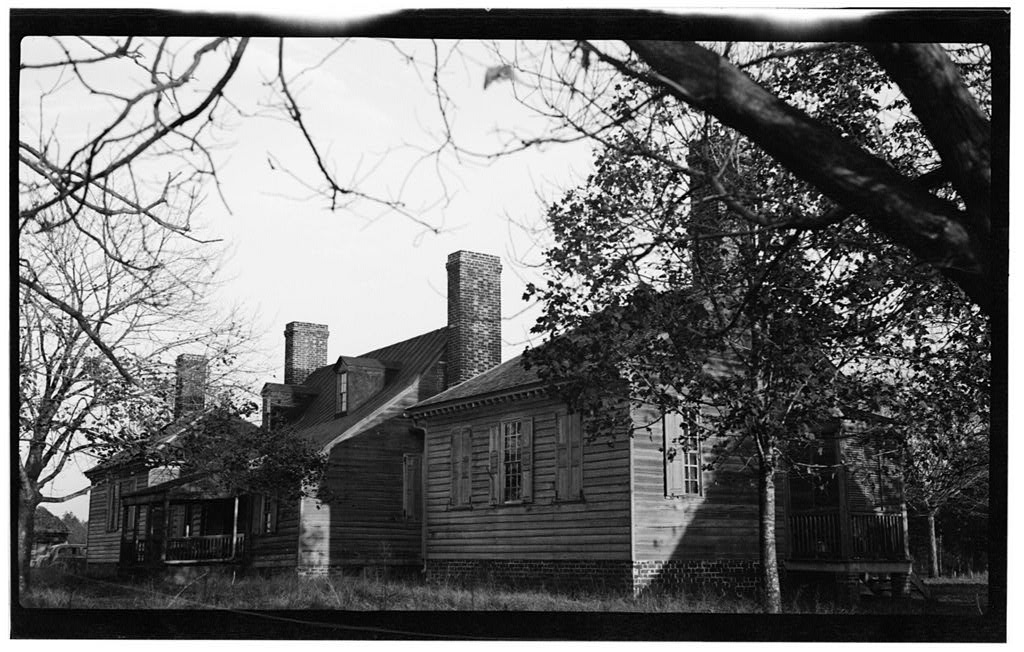
Wales House, Dinwiddie County, Virginia. Photograph by Howell Briggs, 1933. Historic American Buildings Survey (HABS), Library of Congress.
The Wales House was documented in 1933 as part of the Historic American Buildings Survey (HABS), a nationwide program initiated during the Great Depression to record historically and architecturally significant structures through photographs, measured drawings, and written data. The HABS program provides an enduring record of buildings that might otherwise be altered or lost over time.
The HABS photographs of the Wales House were created by Howell Briggs, documenting the structure along U.S. Route 460 in the vicinity of Petersburg, within what is now Dinwiddie County, Virginia. These images capture exterior views and architectural details that illustrate the design, materials, and condition of the house in the early twentieth century.
A representative HABS photograph is shown above. The complete photographic catalog, consisting of 26 images, along with detailed descriptive metadata, is preserved by the Library of Congress.
A Visual History of Wales
Explore the architectural evolution and preserved beauty of Wales House through this curated collection of historical photographs. This gallery spans over three decades of documentation, featuring rare interior and exterior views from the 1974 National Register nomination, professional surveys by Calder Loth in 1995, and detailed architectural studies by Gibson Worsham in 2009.
Images courtesy of the Virginia Department of Historical Resources of the Wales House Collection. Used with permission.
Wales featured in American Architect and Architecture, May 1933 (pages 69–70)
View the original article with photographs and measured drawings below (courtesy of Internet Archive):
Direct link (opens viewer in new tab): Open embedded viewer | Full item page: Standard view
Last updated: January 5, 2026
If you have questions, contributions, or problems with this site, email:
Coordinator - Ed Olsen
State Coordinator - Jeff Kemp
If you have questions or problems with this site, email the County Coordinator.
Please do not ask for specific research on your family. I am unable to do personal research.